Volume 2
Archives of a Wall Street Analyst
Buried in Practice
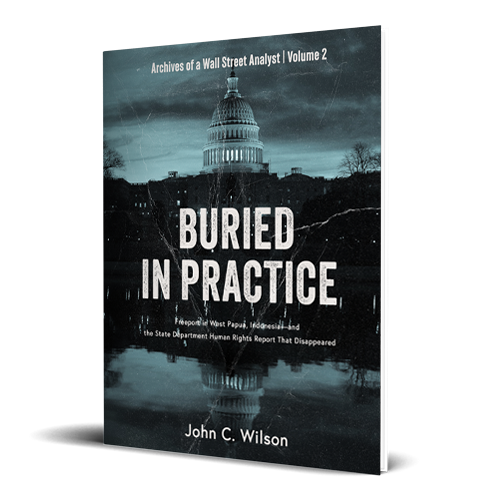
Freeport in West Papua, Indonesia—and the State Department Human Rights Report That Disappeared
What became of the US State Department’s human rights investigation into Freeport-McMoRan in West Papua, Indonesia?
A vanished State Department human rights report. A decade of FOIA battles. “Development aggression” as a lens—grounded in West Papua and compared with thirty high-profile, widely reported global projects marked by allegation, denial, and public controversy.
Readers have heard the terms—transparency, accountability, human rights—yet the machinery that decides what becomes “official truth” often operates out of sight. Buried in Practice is about that machinery: how inconvenient findings can vanish without anyone ever admitting they existed, and how “process” can be used as a substitute for answers.
Buried in Practice is the second volume in Archives of a Wall Street Analyst. It began with a simple question: what became of the US State Department’s mid-1990s human rights investigation into Freeport-McMoRan’s operations in West Papua, Indonesia? Eyewitnesses accused Freeport personnel and Indonesian military forces of deadly violence—killing Indigenous protestors—near the Grasberg mine. The State Department launched an investigation, and then the reports disappeared from public view.
At the center is a missing State Department human rights report tied to that mid-1990s investigation of a major US mining project. After more than a decade of Freedom of Information Act (FOIA) requests, appeals, and litigation, the paper trail has grown—yet the core record—the investigation’s final report— remains absent. The pattern is depressingly familiar. A US House Oversight staff report concluded that “[t]he Executive Branch culture encourages an unlawful presumption in favor of secrecy” when responding to FOIA requests.
The book also examines the revolving door between corporate and government. Wilson has filed a FOIA request seeking any ethics or conflict-of-interest records concerning former US Ambassador to Indonesia J. Stapleton Roy, who later joined Freeport’s board.
Rather than treating the missing report as an isolated anomaly, Buried in Practice argues that it is a symptom of a wider pattern at the intersection of development aggression, US foreign policy, and state management of politically sensitive corporate matters—where scrutiny can be acknowledged in public yet remain “effectively invisible” in the official record.
This volume frames the vanished report as the tip of a larger iceberg: development aggression—the recurring mechanisms that can turn remote extractive projects into zones of coercion, security force violence, intimidation, environmental degradation, displacement, and the narrowing of Indigenous consent. It places the West Papua case alongside thirty comparative examples across projects and jurisdictions—drawn from widely reported, contested controversies where harms are alleged, debated, and often denied—inviting readers to recognize how similar moral trade-offs can repeat under different flags, legal systems, and corporate brands.
Placing his own story alongside, after publishing a March 1996 analyst report flagging political and human rights risk, Wilson was targeted by the FBI with surveillance, workplace interference, attempted entrapment, and intrusion into professional, social and family circles. Later disclosures from FBI operatives—including former girlfriend Susan Holmes, and Steve Garber—sharpen the question of motive and method.
Buried in Practice continues the personal through-line from Volume 1. Information tied to the State Department’s investigation fed into John Wilson’s March 1996 Wall Street analyst report on Freeport—work that he argues triggered the FBI reprisals documented in The Untold Story of the FBI.
The book also tracks the wider pressure environment around the story: call-arounds, probing, FBI coercion and attempted entrapment—plus the way surveillance, infiltration, and targeted recruitment can reach into professional, social, and immediate family circles as a form of intimidation, coercion, and control.
As with Volume 1, Volume 2 is organized in two parts: the book and the archive. The front section (approximately 50–60 pages) provides the introduction, discussion, and overview. It is followed by the archive section: a further 800–900 pages of articles, essays, human rights reports, key State Department cables, correspondence, and related materials—the historical record. In addition to primary-source documents, the archive also contains selected original work by the author, including a comparative project case-study and commentary (Section I) and an essay on West Papua (Section II), that frame the broader issues raised in the volume.
The aim is practical as well as documentary: to bring many of the key sources together in one place, saving readers the burden of tracking them down individually and allowing them to examine the historical record directly rather than rely on summary alone. Like a university course reader, the volume includes core documents for convenience, including materials that may be difficult to locate online or are not publicly available.
- The vanished State Department reporting on Freeport and West Papua: what is known, what is referenced, what was released, and what still has not surfaced.
- The FOIA trail (2013–present): requests, appeals, and litigation—showing points of delay, contradiction, and non-production in the government’s handling of Freeport-related records.
- A comparative “pattern recognition” section: thirty emblematic extractive-industry cases across minerals, oil and gas, agribusiness, and infrastructure—showing recurring dynamics (as alleged by community groups, NGOs, courts, independent reviews, and diverse media coverage) such as militarized security, Free, Prior and Informed Consent failures, pollution, and the criminalization of protest.
- A framework for the bigger problem: how “blame” is distributed across permits, security arrangements, financing, and oversight gaps—so each actor can claim it was only responsible for a “slice” of the system.
- A documentary backbone on West Papua, Indonesia: human rights reports and media/NGO commentary from the mid-1990s to the present, showing the durability of the underlying issues—and why transparency still matters.
- FBI retribution against civil society: building on Volume 1, Wilson extends the discussion of FBI tactics—and cooperating Australian law enforcement and intelligence agencies (including ASIO, ASIS and the AFP)—used to chill dissent in the US and allied countries such as Australia. He examines surveillance, targeting, infiltration, and recruitment pressures, including within the immediate family, and uses a work-related consulting assignment (his engagement with Kroll in New York) as a case study.
Readers interested in corporate accountability, US foreign policy, development aggression, the chilling of civil society (the targeting of domestic critics), human rights, FOIA litigation, and the real-world mechanics of how sensitive findings can be buried “in practice”—and, for those who want to go deeper, a documentary archive you can test for yourself.
Part narrative, part documentary record, Buried in Practice asks a simple question with uncomfortable implications: when a government can acknowledge an investigation yet fail to produce its report, what does that absence reveal about power—and who pays the price?
This second archival volume brings together more than fifteen years of correspondence with the US Department of State, plus court filings and background material—structured to let readers navigate quickly between narrative framing and primary documents.
- Section I: Development Aggression—extractive industries and Indigenous peoples’ rights (comparative cases and patterns).
- Section II: Background on Freeport and West Papua, Indonesia
- Section III: State Department FOIA requests, appeals, and litigation (2013–2025), including the effort to obtain the missing report and a 2026 FOIA request seeking ethics/conflict-of-interest records linked to former Ambassador J. Stapleton Roy’s transition into Freeport roles.
- Section IV: Public references to the investigation and report, plus released State Department cables that confirm key details even as the report itself remains unproduced.
- Section V: Key cables produced by the State Department in relation to FOIA litigation—still no report from the investigation.
- Section VI: Confronting Freeport: clash with civil-society critics and global consequences, including media reports, and blacklisting by major sovereign wealth and pension funds.
- Section VII: Freeport and West Papua, Indonesia—human rights reports.
Hardcover:
ISBN 978-1-7635214-4-5
Paperback:
ISBN 978-1-7635214-3-8
E-book:
ISBN 978-1-7635214-5-2
Coming Soon


